


Why Are Home Prices Still Rising Despite Fewer Buyers?
Updated November 5, 2026
Mortgage rates are elevated, housing affordability remains a major concern, and fewer Americans are purchasing homes. Under normal circumstances, weaker buyer demand should put downward pressure on home prices. Yet prices in many housing markets have remained surprisingly resilient.
Why aren't home prices falling more significantly?
The answer is that higher mortgage rates are discouraging homeowners from selling just as they are discouraging buyers from purchasing. Meanwhile, years of insufficient home construction have left the United States with a substantial housing supply shortage.
This combination helps explain why home sales can decline without triggering a nationwide housing crash. For buyers and sellers in Northern Virginia, understanding the relationship between housing supply, mortgage rates, and homeowner equity is essential when making real estate decisions.
1. The United States Is Still Short Millions of Homes
One of the biggest reasons home prices remain elevated is the country's longstanding housing shortage.
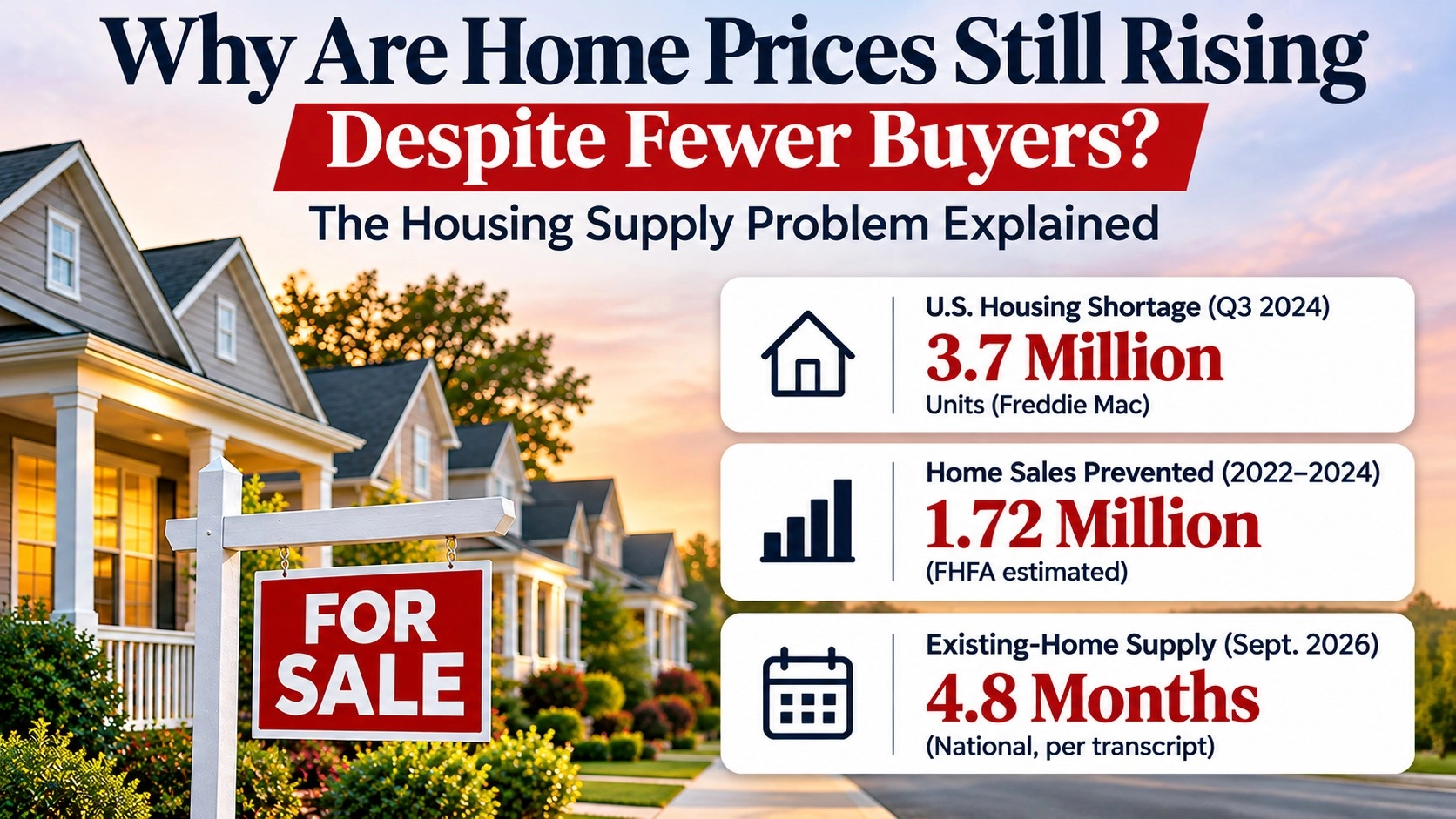
According to Freddie Mac research published in November 2024, the United States had an estimated 3.7 million-unit housing shortage as of the third quarter of 2024. That represented only a modest improvement from the estimated 3.8 million-unit shortage at the end of 2020.
Between those periods, the nation's housing stock increased by approximately 5.8 million units, while the number of households grew by 6.3 million. The underlying shortage therefore remained substantial.
The shortage reflects more than the number of homes currently listed for sale. It also considers households that would likely form if suitable, affordable housing were available.
Source: Freddie Mac housing supply research.
In Northern Virginia, housing demand is influenced by employment opportunities, transportation access, established neighborhoods, and proximity to Washington, D.C. These factors help explain why Northern Virginia homes remain desirable, even when borrowing costs limit affordability.
2. Higher Mortgage Rates Are Keeping Homeowners From Selling
Higher mortgage rates typically reduce housing demand because buyers face larger monthly payments. However, they also discourage existing homeowners from listing their properties.
Millions of Americans purchased or refinanced homes when mortgage rates were below 4%. Selling those properties often means giving up an exceptionally affordable mortgage and replacing it with a substantially more expensive loan.
Consider a homeowner with a $300,000 mortgage:
| 30-year mortgage rate | Monthly principal and interest |
|---|---|
| 3% | Approximately $1,265 |
| 7.4% | Approximately $2,077 |
| Monthly difference | Approximately $812 |
Illustrative calculations based on the rates discussed in the source video; excludes property taxes, insurance, and other housing costs. The 7.4% figure is not a current rate quote.
For a homeowner considering a move, that additional monthly expense can outweigh the benefits of purchasing a different property.
Some homeowners decide to stay longer. Others keep their existing homes as rental properties rather than selling them.
Our article on how rising mortgage interest rates affect home buying and affordability explores why even relatively small changes in interest rates can substantially influence purchasing power.
3. The Mortgage Lock-In Effect Is Supporting Home Prices
Economists refer to homeowners' reluctance to surrender low mortgage rates as the mortgage lock-in effect.
Research from the Federal Housing Finance Agency estimated that this effect prevented approximately 1.72 million home sales between the second quarter of 2022 and the second quarter of 2024.
These were transactions that researchers estimated would otherwise have occurred.
The same research estimated two opposing effects:
- Reduced housing supply: Mortgage lock-in increased home prices by approximately 7% in the researchers' model.
- Higher borrowing costs: Higher interest rates directly reduced home prices by approximately 5.6% in the model.
These figures represent estimated effects, not two separate changes directly observed in national sale prices.
The important conclusion is that reduced housing supply can offset some of the downward pressure caused by weaker buyer demand.
Source: Federal Housing Finance Agency — The Lock-In Effect of Rising Mortgage Rates.
4. Why Today's Housing Market Is Different From 2008
Whenever home sales slow, comparisons with the 2008 housing crash become common. However, the financial conditions behind the two periods are substantially different.
Before the 2008 crash, many homeowners had adjustable-rate mortgages, limited equity, or loans originated under weak lending standards. When financial conditions deteriorated, distressed owners were forced to sell, contributing to a surge in housing inventory.
Today, most outstanding mortgages have fixed interest rates. Rising market rates generally do not increase the principal-and-interest payment on those existing loans.
Additionally, many homeowners have accumulated significant equity, while a substantial share own their properties outright.
That financial flexibility allows sellers to wait for acceptable offers rather than immediately reducing prices.
A slowdown in transactions does not automatically create a housing crash. A sharp downturn is more likely when many homeowners must sell under financial pressure.
Still, homeowners are not immune to unemployment, rising insurance costs, property taxes, or unexpected financial difficulties.
5. More Homes for Sale Are Giving Buyers Greater Negotiating Power
Although housing supply remains constrained in many markets, inventory has improved from the exceptionally tight conditions experienced earlier in the decade.
The source video reports approximately 1.6 million existing homes available nationally in September 2026, representing 4.8 months of supply. It also cites a national median existing-home sale price of approximately $417,500.
These figures describe September 2026 conditions rather than live November inventory.
Additional listings can benefit buyers by reducing competition and providing more opportunities to negotiate.
Buyers may encounter:
- Longer marketing periods for certain properties.
- More price reductions on overpriced listings.
- Seller contributions toward closing costs.
- Greater flexibility regarding inspection contingencies.
- Additional time to compare competing properties.
However, the balance of power differs across neighborhoods and price ranges. Our analysis of whether Northern Virginia is a buyer's market in 2026 examines why market conditions cannot be summarized by a single national statistic.
6. Why Seller Concessions Can Hide Changes in Home Prices
One important distinction is the difference between a property's recorded sale price and the economic terms of the transaction.
Suppose a home sells for $600,000, but the seller agrees to contribute $12,000 toward the buyer's closing costs.
The recorded sale price may still be $600,000, even though the seller's net proceeds are reduced by the concession.
As buyers become more sensitive to monthly payments, concessions can sometimes be more valuable than modest reductions in asking price.
For example, a seller contribution might help cover closing expenses or an eligible mortgage-rate buydown, subject to loan-program limits.
That is why evaluating the full contract matters more than looking only at the final recorded price.
Our Northern Virginia housing market analysis of financing, contingencies, and seller subsidies provides additional context for understanding these negotiations.
7. What Northern Virginia Homebuyers Should Do
Buyers should not assume that a slower national housing market guarantees substantial discounts in every Northern Virginia neighborhood.
Housing conditions in Arlington, Alexandria, Fairfax County, Loudoun County, and Prince William County can vary considerably.
Even within the same city, a condominium, townhouse, and detached single-family home may experience very different levels of competition.
Before submitting an offer, buyers should:
- Study recent closed sales: Focus on comparable properties sold within approximately 60–90 days, expanding the period when transactions are limited.
- Evaluate active competition: Review comparable listings, pending sales, and recent price reductions.
- Understand monthly affordability: Include mortgage payments, property taxes, insurance, and HOA or condominium fees.
- Investigate property condition: Consider the cost of major repairs, renovations, and deferred maintenance.
- Negotiate strategically: Consider price, seller credits, contingencies, and closing flexibility.
For a broader purchasing framework, read our step-by-step guide to finding your dream home in Northern Virginia.
8. What Northern Virginia Home Sellers Should Know
Limited housing inventory can support property values, but it does not mean sellers can ignore affordability concerns.
Buyers facing higher mortgage payments are often more selective about property condition, layout, location, and overall value.
Homes that are overpriced relative to comparable properties may remain on the market longer, even when local inventory is relatively limited.
Successful sellers should evaluate recent comparable sales, current competing listings, and the concessions buyers are requesting.
Pricing correctly from the beginning can be especially important because repeated reductions may weaken a listing's position in the market.
Our guide to pricing your Northern Virginia home without leaving money on the table explains how sellers can balance competitive positioning with their financial goals.
What Is Your Northern Virginia Home Worth?
National housing statistics don't determine your home's value. Recent neighborhood sales, competing listings, property condition, and buyer demand all matter.
Get a personalized home valuation from Dell Residential Group before deciding whether to sell.
Get Your Home Value9. Should Homeowners Sell Now or Wait Until Spring 2027?
Homeowners with low mortgage rates face a particularly difficult decision.
Keeping an existing mortgage may offer substantial financial advantages. However, remaining in a home that no longer meets your needs also has costs.
For example, a homeowner who needs more space, wants to downsize, or plans to relocate should compare the cost of moving today against the financial and lifestyle consequences of waiting.
Waiting for lower mortgage rates does not guarantee better purchasing conditions. If borrowing costs decline, more buyers may enter the market and increase competition for available homes.
Conversely, homeowners who have flexibility may benefit from taking additional time to prepare their properties and evaluate market conditions.
We examine these tradeoffs in Should You Sell Your Northern Virginia Home Before Spring 2027?
10. Could Home Prices Fall in 2027?
Yes. Housing shortages and mortgage-rate lock-in do not guarantee continued price appreciation.
Prices could decline if the number of homes for sale grows faster than buyer demand, affordability worsens, unemployment increases, or more owners experience financial distress.
Foreclosures and other forced sales are especially important because financially distressed sellers may have less flexibility to wait for favorable offers.
However, price corrections do not necessarily occur evenly across the country.
A neighborhood with substantial new construction, weak buyer demand, or increasing inventory could experience declining values while another community remains competitive.
Even when nominal home prices increase slightly, homeowners can experience a decline in inflation-adjusted value if appreciation fails to keep pace with the broader cost of living.
For Northern Virginia buyers and sellers, local inventory, recent comparable sales, employment conditions, and property-specific demand provide more actionable information than predictions of a nationwide housing crash.
Frequently Asked Questions About Rising Home Prices
Why are home prices rising when fewer people are buying?
Home prices can rise when the supply of available homes remains limited relative to buyer demand. Higher mortgage rates have discouraged many homeowners from selling, restricting inventory even as fewer buyers qualify for mortgages.
How large is the U.S. housing shortage?
Freddie Mac estimated that the United States faced a housing shortage of approximately 3.7 million units as of the third quarter of 2024. That is a historical estimate, not a verified November 2026 figure.
What is the mortgage lock-in effect?
The mortgage lock-in effect occurs when homeowners hesitate to sell because their existing mortgage rates are substantially lower than rates available on a new loan.
Will lower mortgage rates cause home prices to fall?
Not necessarily. Lower rates may encourage additional homeowners to list their properties, but they can also bring more buyers into the market. The impact on prices depends on how supply and demand respond.
Is Northern Virginia experiencing a housing crash?
Slower transactions or price reductions on individual listings do not, by themselves, establish a regional housing crash. Buyers and sellers should evaluate current local sales, inventory, and price trends before drawing conclusions.
Should buyers wait until home prices decline?
Waiting can be reasonable for buyers who need additional savings or financial flexibility. However, attempting to predict the exact bottom of the housing market is difficult. A purchase should be based on affordability, property suitability, and long-term plans.
The Bottom Line: Fewer Buyers Do Not Automatically Mean Lower Home Prices
The housing market is experiencing two competing forces.
Higher mortgage rates reduce the number of buyers who can afford to purchase homes. At the same time, those rates discourage existing homeowners from selling and surrendering their low-cost mortgages.
Combined with the country's longstanding housing shortage and the financial resilience of many existing homeowners, this helps explain why prices can remain stable or increase even when fewer transactions occur.
For Northern Virginia buyers and sellers, the most important question is not whether national home sales are slowing. It is how supply, demand, affordability, and competition are changing in the specific neighborhood and property category that matters to them.
Navigate the Northern Virginia Housing Market With a Local Expert
Whether you're buying, selling, or deciding when to make your next move, Dell Residential Group can help you evaluate neighborhood-level prices, available inventory, and current negotiating opportunities across Northern Virginia.
Contact Dell Residential Group